
If your car won't start, it's usually due to a faulty car battery . Don't let it get to the point of a breakdown; you can check the condition of your car battery yourself without having to visit a repair shop. With the following step-by-step instructions, you can assess the condition of your car battery yourself.
How do you recognize a weak battery?
The condition of a car's battery deteriorates over time; its lifespan is limited and depends on various factors. According to information from the ADAC (German Automobile Club), a discharged car battery has been the number one cause of breakdowns in recent decades. Whether a car battery is defective or not cannot be tested or predicted with 100 percent certainty.
There are, however, clear warning signs: If the starter motor turns slower than usual when starting the engine, you should urgently recharge your car battery . If the engine starts, the battery will recharge by driving for a longer period of time – a short trip is not sufficient. If the engine doesn't start, you can connect your car battery to the battery of another car using jumper cables available from car accessories and start the engine that way. For more information on jump starting, please also read the jump-start guide . As a preventative measure, you can also test the condition of your car battery using simple methods.
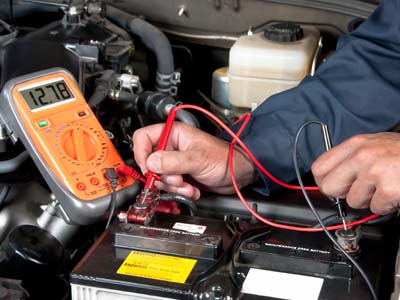
What do you need to measure your car battery?
All you need to test car batteries is a multimeter. This allows you to measure the battery's voltage. Learn more about these devices in our voltmeter guide . You'll need access to the battery to perform the measurement.
How can you measure the level of a car battery?
Simply follow the steps below and quickly check the condition of your car battery.
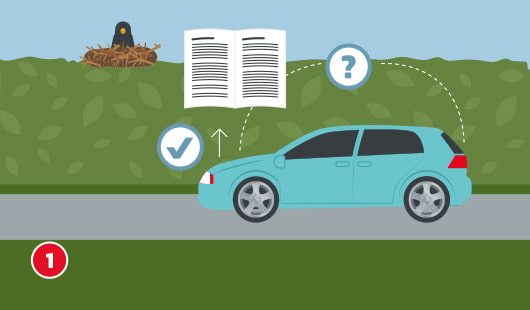
Step 1: Open the hood for the test
- Unlock and open the hood
Most cars have a lever located in the driver's footwell to open the hood. Pulling this lever unlocks the hood, allowing you to open it. You usually have to release a lock on the hood itself to do this. In some models, however, the car battery is located in the rear of the car. Refer to your car's owner's manual for further information on the battery's location.
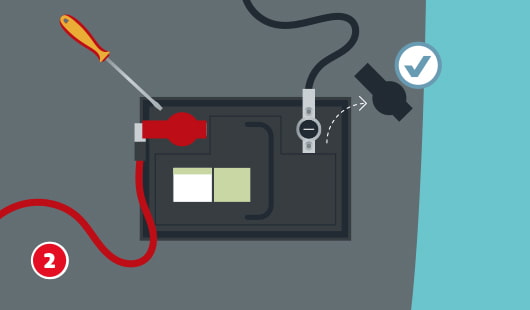
Step 2: Expose the battery in the engine compartment
- Remove any protective covering
- Expose the positive and negative poles
Have you found your car battery? It's usually located on the right or left side of the engine compartment. Some vehicles have a cover that you'll need to remove to access it. Now expose the positive and negative terminals . In some cars, you'll need to unscrew a plastic cover protecting the terminals.
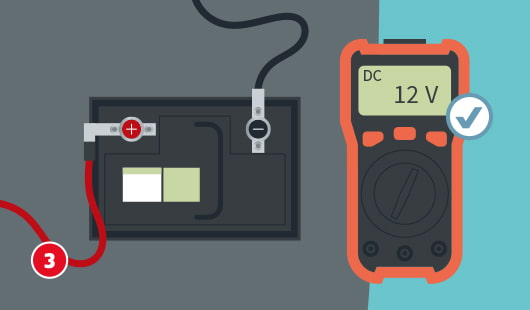
Step 3: Set the multimeter correctly
- Set multimeter to direct current
- Select measuring range for a voltage of 12 volts
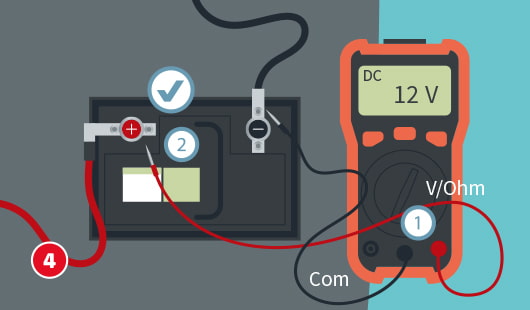
Set the multimeter's selector switch to direct current (DC) and select a measuring range that can display a voltage of 12 volts . If the measuring range is set too low, the multimeter will display an infinite value; if the measuring range is set too high, no usable value will be displayed.
Step 4: Connect the multimeter
- Connect the red cable to the positive pole
- Connect the black cable to the negative pole
The red test cable goes into the V/Ohm socket, the black cable into the COM socket. Only after the test cables are connected to the multimeter can you make the connection to the car battery terminals. Connect the red cable to the positive terminal, the black cable to the negative terminal.
Step 5: Evaluation of the measurement results
- Read voltage and recharge if necessary
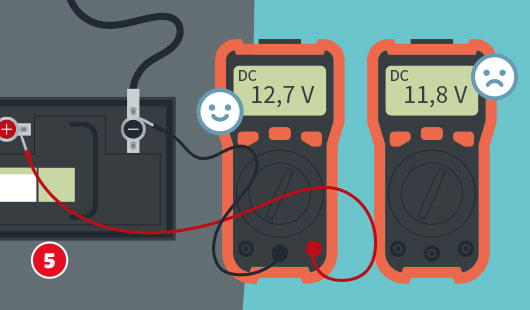
Read the voltage; it should be more than 12 volts . If the reading is lower, it's time to recharge, and the battery may be defective.
What do you do if your car battery is weak?
A battery charger allows you to charge your battery as much as possible without having to drive long distances. If the voltage drops below 12 volts after charging, the battery is defective, and you'll need to buy a new one to ensure your car starts reliably and avoid having to call a mechanic.
 What is the advantage of a maintenance-free battery?
Unlike a conventional car battery with openings for refilling with distilled water, a maintenance-free battery is sealed, so you can't test the fluid level. No maintenance is required. If the battery can be opened, you can test the charge density of the cells with a battery acid siphon.
What defects can't you detect yourself when testing car batteries?
Batteries usually last between five and ten years, after which it's time for a new one. A multimeter can only measure the voltage,